

Learning how to keep a tidy house in your 20s sounds simple until real life gets involved. Work, university, commuting, social plans, flatmates, laundry, food shops, admin, bills and that very specific end-of-day tiredness can make even a small flat feel like another full-time job.
And no, it does not mean you are messy, lazy or “bad at adulting”. Most of the time, the problem is more practical: you are building your own routine while trying to keep your space from becoming a never-ending to-do list.
The good news is that you do not need a perfect home, a colour-coded cleaning rota or a full Sunday reset every week. You need a system you can actually repeat: a few daily habits, a realistic weekly reset, clear rules if you live with other people and the ability to delegate the tasks that drain the most time.
This guide explains how to keep your home in order in your 20s without turning your life into a productivity project. It covers simple routines, flat-share basics, what to delegate when you are short on time and how at-home cleaning services can fit into a busy UK lifestyle.
The system at a glance:
- A daily 10-minute tidy
- Keep the kitchen usable
- Finish laundry cycles before they pile up
- A simple weekly cleaning schedule for home
- Clear flatshare rules — and book help when the heavy jobs keep slipping

How to keep your home in order in your 20s when life gets busy
Keeping your home in order is hard in your 20s because your routine is often still changing. You may be renting, flat-sharing, studying, working full-time, working from home or doing several of those things at once.
However, most household tasks are not difficult on their own. Making the bed, doing the washing-up, putting a load of laundry on, hoovering, wiping the kitchen counter or taking the bins out are all small actions. The problem is that they come back constantly.
As a result, mess can feel so tiring. It is not just visual. It becomes mental noise. For example, clothes on a chair remind you about the laundry. Meanwhile, mugs by your desk bring the washing-up to mind. A neglected bathroom adds another job before the weekend. Finally, a cluttered kitchen can make cooking feel like it already comes with an extra task.
At the same time, in your 20s, there is often less structure. Some days you eat at home, some days you are out. Some weeks you work from the office, others from your bedroom or kitchen table. You may have late nights, early starts, changing schedules or flatmates whose standards are very different from yours.
Therefore, trying to keep everything spotless every day is usually unrealistic. A better goal is to stop your home from adding unnecessary stress to your week.
It helps to separate two ideas:
- Tidiness: things are mostly where they should be, and you can use your space without chaos.
- Cleanliness: surfaces, floors, bathroom, kitchen and shared areas are hygienic and cared for.
For example, you can have a fairly tidy flat that still needs a proper clean. You can also clean a lot, but if there is no basic system for putting things away, the mess returns almost immediately.
Ultimately, the aim is not perfection. The aim is to make your home easier to live in.
Read more practical home and lifestyle advice on the Webel Blog.
Minimum routines and a simple cleaning schedule
The best home routine is not the most ambitious one. It is the one you can still follow on a normal week, when you are tired, busy and not feeling especially motivated.
Instead, start with minimum routines rather than trying to do everything. These are small actions that stop your home from getting out of control.
The 10-minute tidy
A 10-minute tidy is one of the easiest ways to keep your home under control because it focuses only on what you can see and fix quickly.
For example, set a timer and tidy the visible mess: clothes, mugs, plates, shoes, bags, parcels, chargers, receipts, make-up, toiletries or anything that has ended up on a surface where it does not belong.
In other words, you are not deep-cleaning. You are simply bringing the room back to a usable state.
As a result, this approach works especially well in small flats or bedrooms, where a few items can make the whole space feel messy. If 10 minutes feels too much, do five. The point is repetition, not intensity.
Keep the kitchen usable
If you only keep one area under control, make it the kitchen. A messy kitchen makes the whole home feel more chaotic, especially if you cook, work or flat-share.
However, you do not need to leave it perfect every night; instead, try to close the day with the basics done:
- Washing-up done or loaded into the dishwasher.
- Counters mostly clear.
- Food put away.
- Bins under control.
- Sink not blocked by plates.
- Hob wiped if you have cooked.
Therefore, waking up to a usable kitchen changes the whole mood of the morning. It also makes it more likely that you will cook, prepare coffee or leave the house without feeling behind before the day has even started.
Do laundry before it becomes urgent
Laundry becomes stressful when you wait until it is urgent. The task is not just washing clothes; it is washing, drying, folding, putting away and sometimes ironing.
If you live alone, one or two loads a week may be enough. If you flat-share, it helps to avoid the classic Sunday evening washing machine traffic jam.
In addition, try to complete the full cycle. Clean clothes left in a basket for three days still create clutter. Drying racks left in the living room all week make the flat feel permanently unfinished. Clothes on the chair become “the chair”, and suddenly the chair no longer functions as furniture.
A practical rule: do smaller loads before the pile becomes dramatic.
Create a basic weekly reset
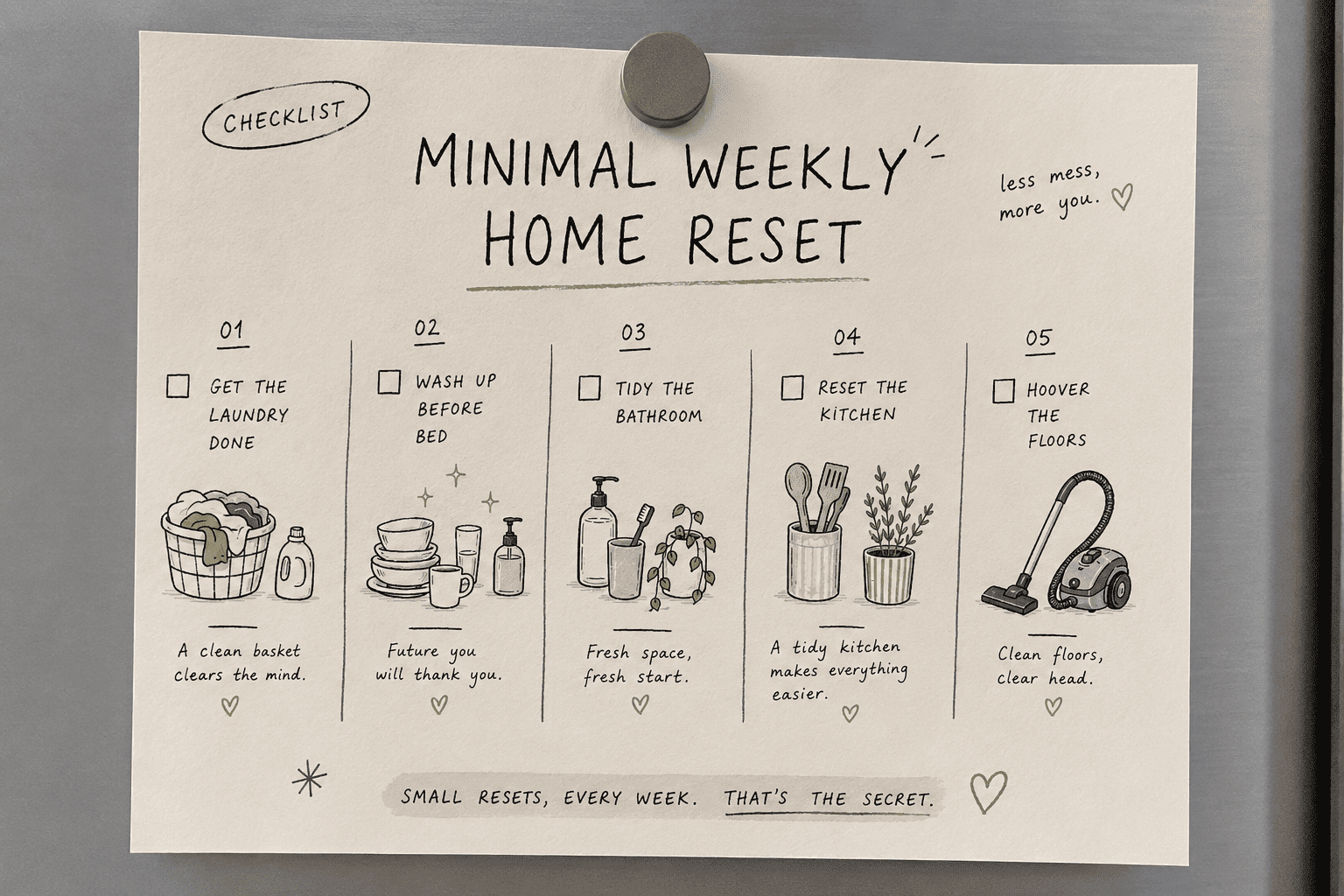
A weekly reset keeps your home from reaching the point where everything needs doing at once. It does not have to be perfect; it just has to cover the basics.
For example, a simple weekly reset might include:
- Cleaning the bathroom.
- Hoovering or sweeping.
- Mopping if needed.
- Wiping kitchen surfaces.
- Changing bedsheets.
- Dusting main surfaces.
- Taking bins and recycling out.
- Checking the fridge for food that needs using or throwing away.
Alternatively, if that feels like too much in one go, split it across the week. Bathroom one day, kitchen another, floors another. The goal is not to become a cleaning person. The goal is to avoid a full-house crisis every weekend.
If you are short on time: what chores are worth delegating
When you are short on time, the goal is not to do every household task yourself. It is to keep the small daily habits that maintain order and delegate the repetitive tasks that drain the most energy.
What to delegate
If you are wondering how to keep your home in order in your 20s when life gets busy, start by deciding what to keep and what to delegate. Cleaning is often the first thing that gets pushed to “later”. Not because you do not care, but because it competes with work, studying, commuting, food shopping, social plans, exercise, rest and everything else that fills the week.
Therefore, the question is not how to do everything perfectly. A more useful question is: which tasks are worth keeping in your routine, and which ones could be delegated so your home does not depend on your last free hour of the day?
For example, some tasks are usually worth keeping yourself because they are quick and help prevent everyday chaos:
- Putting mugs and plates back in the kitchen.
- Clearing visible surfaces.
- Opening windows for a few minutes.
- Putting one load of laundry on before it becomes urgent.
- Keeping the kitchen usable.
- Putting things back after using them.
Best chores to delegate (and when to hire a cleaner)
By contrast, other tasks tend to take more time, energy or motivation:
- Deep-cleaning the bathroom.
- Cleaning the kitchen properly.
- Hoovering and mopping the whole flat.
- Cleaning windows.
- Ironing.
- Resetting the flat before or after guests.
- Catching up after a very busy week.
As a result, these are often the best candidates to delegate. Not because you cannot do them, but because they are repetitive, easy to postpone and often take up more mental space than expected.
Ultimately, delegating is not a failure of independence. If the same jobs keep slipping every week, it may be time to hire a cleaner for a regular or one-off reset. Not because you “failed”, but because your schedule is full.
Book trusted cleaning help without the hassle
Find available professionals, compare profiles and manage your booking directly in the Webel app.
Download the appIf you flat-share: cleaning rota and when to get help
In a flat-share, keeping the home in order depends less on one perfect routine and more on clear agreements. Shared spaces need shared rules.
Agree on shared rules
However, flat-sharing can be fun, affordable and social, but it is also one of the easiest places for tension to build. Everyone has different standards. One person thinks the kitchen is fine. Another thinks it is unusable. One person cleans immediately. Another cleans “later”, which somehow becomes next week.
For this reason, the biggest mistake is relying on hints. Waiting for someone to “notice” rarely works. A simple agreement is usually better.
For example, useful flat-share rules include:
- Separate personal mess from shared mess.
- Decide who is responsible for bins, bathroom, kitchen and floors.
- Set a minimum frequency for shared tasks.
- Agree what happens when someone is away or too busy.
- Put a basic cleaning rota for housemates on the fridge or in a shared chat, and review it if it stops working.
- Avoid making one person the unofficial house manager.
- Keep cleaning supplies somewhere everyone can access.
- Review the rota if it clearly is not working.
When to book help
In addition, it helps to protect deposits and avoid end-of-tenancy stress. In UK rentals, cleanliness can become a bigger issue when inspections, guests or moving out are involved. Keeping shared areas under control makes life easier before it becomes urgent.
When does it make sense to book help? When cleaning becomes a repeated source of arguments, when nobody realistically has time, or when the shared areas need a reset that is bigger than a quick tidy.
For example, flatmates might agree to keep personal items out of the kitchen and book a cleaner weekly or fortnightly for the bathroom, kitchen, floors and shared spaces. That does not replace personal responsibility, but it can reduce the recurring conflict around heavier tasks.

Deep clean vs regular clean: what to expect from a home cleaner
At-home cleaning can help with the tasks that are easiest to postpone: bathrooms, kitchens, floors, dusting, deep cleans and general resets. What is included depends on the professional, the time booked and the details you provide.
Choose the right type of clean
For example, a home cleaning service is usually most useful when you are clear about what you need. For example, a regular clean keeps bathrooms, kitchens and floors under control; a deep clean is for resets after guests, a busy month or before moving.
Depending on the professional and service, you may then be able to request:
- Bathroom cleaning.
- Kitchen cleaning.
- Hoovering and mopping.
- Dusting.
- Bedroom or living room reset.
- Window cleaning.
- Ironing.
- Deep cleaning.
- Move-in or move-out cleaning.
- Cleaning after a gathering.
What affects price and duration
In addition, the price and duration can vary depending on several factors:
- Size of the home.
- Number of rooms.
- Condition of the space.
- Type of cleaning needed.
- Whether it is a one-off or recurring booking.
- Whether ironing or specific tasks are included.
- Whether materials are provided by you or the professional.
- Availability and profile of the professional.
Therefore, if you are not sure where to start, a good first booking is usually a general reset. After that, you can adjust the duration, frequency and priorities based on what made the biggest difference.
Moreover, the advantage of booking through Webel is that you can look for available professionals, compare profiles, check ratings and manage the booking from the app. Instead of coordinating everything through scattered messages, the process is kept in one place.
Learn how Webel works and how to book home services from the app.
Find available home service professionals near you
Compare options and book help for cleaning, ironing and other home services directly through Webel.
Download the appHow to book on Webel
Booking on Webel is designed to be simple: choose the service, add your address, compare professionals, select a time and manage the booking from the app.
Booking step by step
The general flow is:
- Choose the service you need.
Select cleaning, ironing or another home-related service. - Add your address.
This helps the app show professionals who can work in your area. - Compare professionals.
Review profiles, prices, ratings and availability before choosing. - Select date, time and details.
Add the information that matters: size of the home, priorities, pets, access notes, ironing, materials or anything the professional should know. - Book and pay online.
The booking and payment are managed through the app, so everything is recorded in one place. - Wait for confirmation.
Once the professional confirms, you are ready for the appointment.
Prepare for the appointment
Before the service, however, it helps to make the job easier to complete. You do not need to clean before the cleaner arrives, but clearing obvious clutter can help the professional spend more time on the tasks you actually care about.
For example, if you book cleaning, move clothes, plates or small items off surfaces where possible. If you book ironing, keep the clothes together. If you live with flatmates, make sure shared spaces are accessible.
Book trusted cleaning help without the hassle
Save time on repetitive home tasks and manage your booking from the Webel app.
Download the appFAQ
How can I keep my home tidy if I have very little time?
Start with small routines: a 10-minute reset, a usable kitchen, laundry before it becomes urgent and one weekly cleaning routine. You do not need to do everything perfectly. Therefore, the main goal is to stop tasks from piling up until they feel impossible.
How often should I clean my flat?
Most homes benefit from a weekly basic clean, especially bathrooms, kitchens and floors. The exact frequency depends on how many people live there, whether you have pets and how much time you spend at home.
What chores are worth delegating?
The best chores to delegate are the ones that take the most time, create the most stress or keep getting postponed. Cleaning bathrooms, kitchens, floors, windows and ironing are common examples.
Is at-home cleaning only for big houses?
No. At-home cleaning can be useful in small flats, studios and flat-shares too. In smaller spaces, mess often becomes visible faster.
What should I do if my flatmates do not clean?
Agree on clear rules instead of relying on hints: who does what, how often, and what happens if someone cannot do their task. If cleaning keeps causing arguments, consider booking help for shared areas.
How long should I book a cleaner for?
It depends on the size and condition of your home, plus what you want included. A basic maintenance clean usually takes less time than a deep clean or a full reset.
Do I need to provide cleaning products?
It depends on the professional and the service. Always check the booking details and add a note if you have specific products, surfaces or preferences.
Can I book cleaning as a one-off?
Yes. One-off cleaning can be useful before guests, after a busy week, after a party, before moving out or whenever the home needs a reset. Alternatively, you can choose recurring help if you want to keep your home under control with less weekly effort.
Ultimately, learning how to keep your home in order in your 20s is not about having a perfect flat. It is about creating a system that fits your real life: small habits, clear expectations and help when a task takes more time or energy than you want to give it.
Your home should be a place where you can rest, work, invite people over or simply feel comfortable. If cleaning, ironing or household admin starts taking up too much space in your head, it may be time to delegate.
Explore more home and lifestyle advice on the Webel Blog.
Find available home service professionals near you
Book cleaning, ironing and other home services from one app, without the back-and-forth.
Download the app